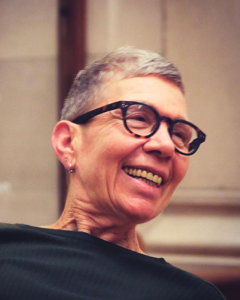
I want to look at the work of Beverly Buchanan (1940–2015) through the prism of a three-fold invisibilisation: 1) That of the individual stories of Black people descended from the enslaved in the American rural South. 2) That of butch lesbians; even if Buchanan didn’t identify as such (we lesbians clock her queerness immediately). 3) That of a racialised memory of class, which highlights Black American thinkers such as Saidiya Hartman, who associates this memory with the afterlife of slavery. As she explains, ‘If slavery persists as an issue in the political life of black America, it is not because of an antiquarian obsession with bygone days or the burden of a too-long memory, but because black lives are still imperilled and devalued by a racial calculus and a political arithmetic that were entrenched centuries ago. This is the afterlife of slavery – skewed life chances, limited access to health and education, premature death, incarceration, and impoverishment.’1
This invisibilisation is inscribed in plain sight in Buchanan’s work, to borrow the English expression of ‘hiding in plain sight’: to conceal oneself before the eyes of all, in broad daylight, like Edgar Allan Poe’s purloined letter.2 I love the paradox of something hidden in plain sight, which has become a commonly used term to explore the history of unexamined racism and its relationship to visual culture in the United States. It comes up a lot when discussing Beverly Buchanan, describing not only the situation of the artist within critical discourse, but perhaps also a more active tactical stance initiated by the artist herself.
In a text describing the pilgrimage he makes to Marsh Ruins (1981) in the Marshes of Glynn Overlook Park in Brunswick, Georgia, Siddharta Mitter writes: ‘Here is a major work of American outdoor sculpture, hiding in plain sight (…).’3 From afar, it resembles a cluster of haphazardly arranged boulders that are in reality cement structures built out of ‘tabby’. A historical material particular to the region, it’s a type of concrete composed of oyster shells, lime, sand, ash and water, produced by enslaved peoples and largely used in the plantation architecture of the American Southeast before the Civil War.
If these figures crafted by the artist take on the appearance of supposedly ‘natural’ formations, it may be because their induced mimicry dooms them to a form of disappearance while simultaneously offering them protection. Is this not, then, a way of at once naturalising and protecting the history of the Igbo Landing? In 1803, on this same coast of Georgia, a group of around 75 captive Igbo Africans4 opted to drown themselves in a mass suicide, rather than submit to enslavement. It is a foundational narrative of the Afro-diasporic resistance, evoked by Toni Morrison (Song of Solomon), Julie Dash (Daughters of the Dust), and Beyoncé (Lemonade). If Buchanan was also referencing it, she didn’t confirm their direct connection to her sculptures, just as she let the rock formations efface themselves into the landscape. Indeed, Buchanan left them ‘in plain sight’, indistinguishable from their surroundings and surviving nevertheless, while still inviting our attention (she signed and dated them after all), and prompting us to ask hard questions: who controls historical narratives? What do we choose to preserve? What do we allow to deteriorate into oblivion?
‘A lot of places like this are comforting in their dark interiors as well as confining in their smallness of breathing room interiors. In trying to present a feeling for an interior as well as show the exterior look of this work, I had to spend some time standing and sitting inside this structure and thinking about where, for example, the coffeepot would stay and how large the table had to be away from the window and where the hat nail goes and what kind of bed to make for sleeping more than one person […]’Beverly Buchanan, ‘Shack South: Inside & Out’, Athens, Georgia, 1990.
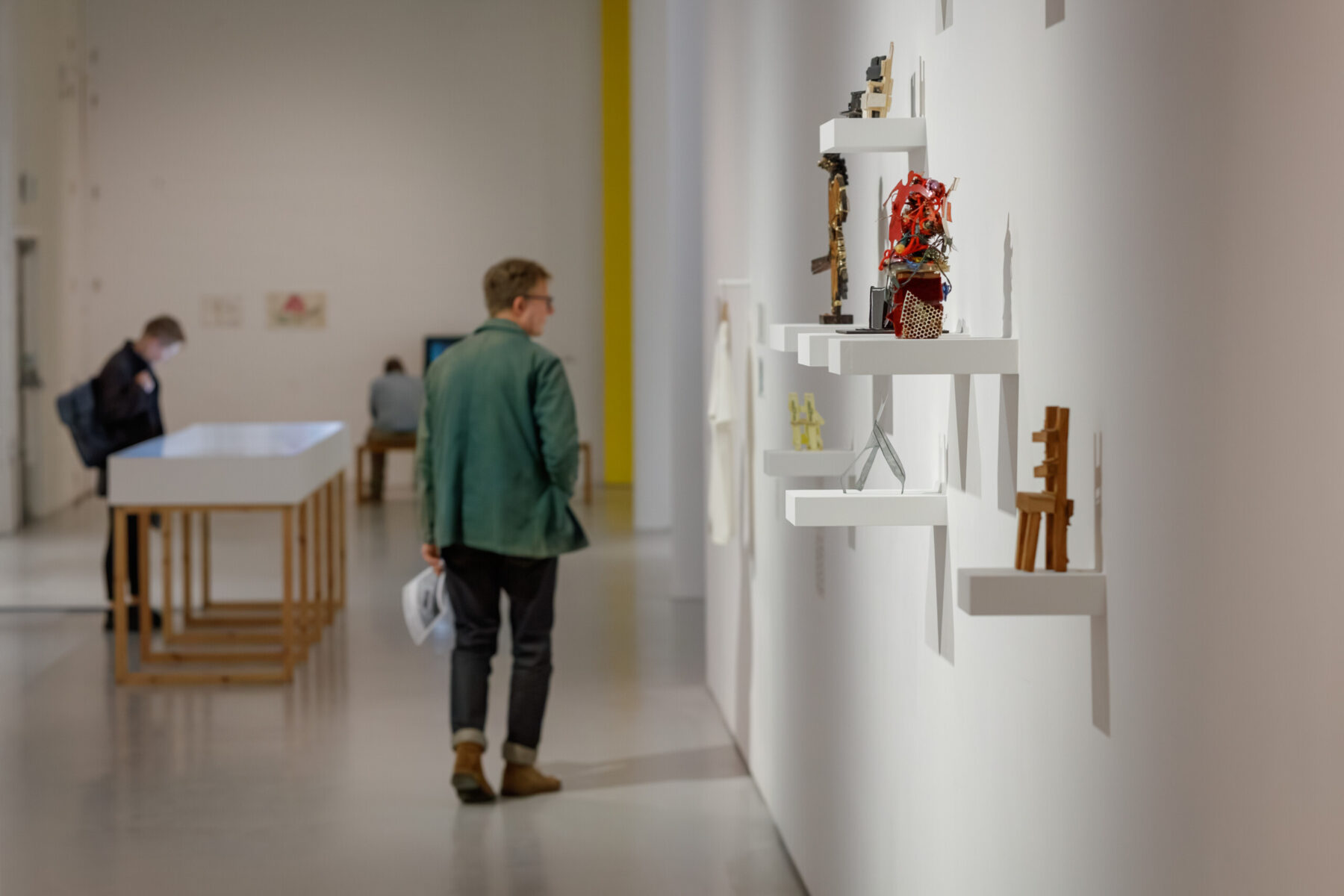
These resonances echo in the artist’s life, as they do in each of her environmental sculptures, ephemeral works and performances, which the exhibition Beverly Buchanan: Weathering at Spike Island can only document. For example, Ruins and Rituals (1979) on the grounds of the Museum of Arts and Sciences (Macon, Georgia); or Unity Stones (1983) in black-painted concrete in front of the Booker T. Washington Center (Macon, Georgia). However, photographs and films allow us to get an idea. Presented here across three screens is a video by artists Park McArthur and Jason Hirata and curator Jennifer Burris. McArthur and Burris organised a major exhibition of her work in late 2016 at the Brooklyn Museum in New York, embedding her in the art historical discourse of the late 20th century, while at the same time a more intimate exhibition in Atlanta located her within the American South and its histories of resistance to injustice.
Not that Buchanan was a complete unknown. After studying science and medicine, she was taken under the wing of those she called her mentors, Romare Bearden and Norman Lewis, who exhibited her work in their artist-run space Cinque Gallery, while her friend Ana Mendieta invited her to participate in the 1980 exhibition she organised at A.I.R. Gallery in New York. Dialectics of Isolation: An Exhibition of Third World Women Artists of the United States was a landmark exhibition: it was the first to explicitly challenge the notion of a singular, white feminism. During her years in New York and New Jersey, and even afterwards, Buchanan showed in several galleries (including Betty Parsons Gallery, and most notably, with Parson’s ex-assistant, Jock Truman, in 1977). But when you leave New York to settle in Georgia, as she did in 1977, that’s when you throw on your invisibility helmet and become an artist-of-all-trades. And that is what Buchanan did – presenting herself as a painter, sculptor, model-maker, documentarian, photographer, illustrator, fanzine maker, landscaper and producer of ephemera, calendars, greeting cards… in other words, like a ‘Renaissance Artist’, which is how she fashioned herself on one business card. And then you leave your career ‘hiding in plain sight’ to a benevolent posterity, one that may someday allow you to be rediscovered and loved posthumously, as is the case today.
‘What sort of object is a ruined ruin?’ asks Amelia Groom in her book dedicated to Marsh Ruins (1981).5 I have the sense that Buchanan, by way of an answer, would lean into the object’s capacity for transformation and its possibility for play (in French, the word jeu encompasses play, gambling, and the looseness – the give – between things). Her Frustulas, these concrete and pigment sculptures, thus make use of their material properties: at once heavy and durable, but at the same time vulnerable to environmental changes. Placed directly on the floor, side by side or one atop the other, the Frustulas are cast from moulds of milk cartons and found dislodged bricks. In turn they echo the devastated walls of New York in the 1970s and 80s: in the Bronx, for example, where buildings were frequently torched by less than scrupulous landlords. As we can see, this has very little to do with endorsing a romantic nostalgia for ruins. Rather, it’s about undermining the euphemistic impulse of a triumphant type of sculpture: the vertical kind, that thrusts the glory of great men towards the heavens, turning them into statues of a fixed and polished unity, with no room left for shadows. What we might call a public monument. And it is precisely this that Beverly Buchanan dismantles in these ‘sorts of objects that are ruined ruins’.
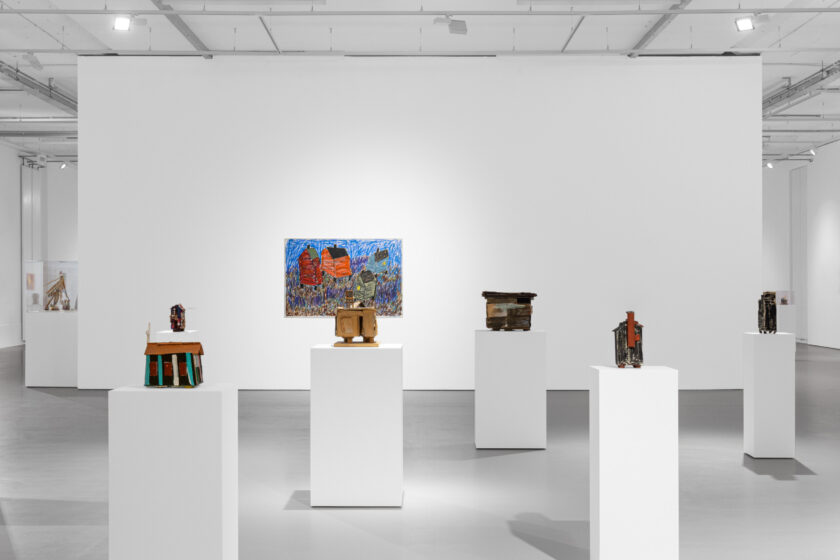
The shacks follow this sculptural logic. They have their origin in the handmade houses built of salvaged wood, that stand as an architectural legacy of slavery along the backroads of southern Georgia or amidst the trees of South Carolina. As the story goes, as a child Buchanan drove through these places with her father, dean of the School of Agriculture at South Carolina State College. Before she left for New York, during her second life in Macon, Atlanta and Athens, and even after she moved to Michigan in 2003, she researched these shacks and their inhabitants, often using the outhouses present as landmarks. The shacks are often accompanied by legends, handwritten or typed stories where she recounts (reconstitutes and fictionalises) the emotional experiences associated with them. There is also the physical and emotional descriptions of the shacks, expressed through painting, in oil pastels, coloured crayons, in assemblages of cardboard, metal, wood, or even photographed, photocopied, and arranged in booklets… Presented in Spike Island’s central gallery is one of the only examples of Buchanan’s ‘interiors’ whose furnishings she built out of salvaged wood and nails. A sink, a chair, a table, and a bed are strewn around the shack, emphasising its cramped proportions. All of these furniture elements are wonky; in the drawings, the houses – sometimes equipped with feet – slant and lean, their construction revealing their disjointed slats. And yet, they hold up. It is precisely in this precarity, writes Patricia Ekpo, in this place and this manner of making ‘that blackness emerges in Buchanan’s sculptural shacks’.6
‘I would look at a building and it would remind me of a person or a family,’ said Buchanan. And she insisted: ‘I want to give people who can neither read nor write but made all the measurements and built their own barns and shacks a different way of looking at themselves.’7
Some of the shacks are localised in their more or less vague titles (South Florida [Hurricane House Series]; Untitled [Athens, GA]). Others are named after their material properties (Tin and Wood House) or a distinguishing detail (Turned Over House). But most often, they’re dedicated to their inhabitants (Homage to Juanita; For Mallory; Tribute to Mary Lou Furcron…). It seems that Buchanan sometimes combined the traits of several people into one shack dedicated to Miss Mary, Miss Tiny Aiken, Miss Lovie, Miz Hurston… Her attention almost always skews towards elderly, single Black women. I inevitably think, though in a rural setting quite different from the urbanity described by Saidiya Hartman, of the single Black women in Wayward Lives.8 Buchanan also tended to invent what the historian calls ‘a mode of close narration, a style which places the voice of the narrator and character as inseparable, so that the vision, language, and rhythms of the wayward shape and arrange the text.’9
For these women, and with them in mind, Buchanan seeks to shift our perspective of the home. By which I mean, to not put it upright, domesticate it, or set it ‘straight’, according to the criteria born of a white, heteronormative economy and world view. Here we must take into account the debt, the indebtedness that the emancipation of Black people instituted. ‘To be free was to be a debtor’, explains Hartman, ‘it meant to be plunged into an endless cycle of debt, an “already accrued debt, an abstinent present, and a mortgaged future”.’ This is where an idea I love comes into play, that of the dedication, which as Roland Barthes puts it, ‘has no other meaning than the actual gesture by which I present what I have done (my work) to someone I love or admire’.10 With the dedication, an unknown force enters the canonical tête-à-tête between the work produced and the producer’s subjectivity. Buchanan’s empathy is made manifest through showing such constant dedication. She makes place for other people’s stories and herstories instead of focusing on the persona of the ‘diva’, as she calls herself, her economy of survival, and the medicalisation of her life.
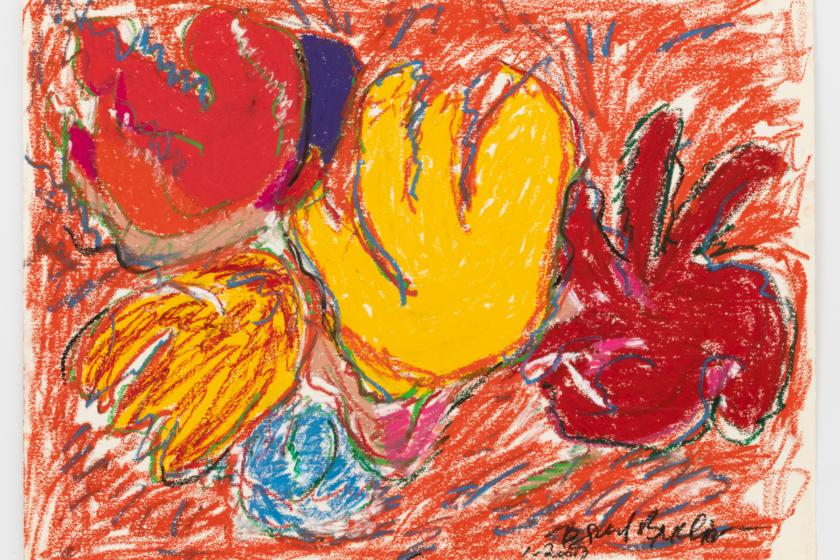
Beyond the remarkable self-deprecating humour of the diva in question, it is indeed the anecdotal and ephemeral that inscribe themselves in the sculptural episodes Buchanan produced; notably with the innumerable undocumented pieces, gifted to her neighbours, friends, lovers no doubt, pharmacists, people who counted, those who were invented to count. ‘She might add a tabby brick to a graveyard; place an ephemeral rock arrangement by the roadside; immerse a concrete piece in the Ocmulgee River to sink, or a wood one to drift away. She kept materials to these ends in her yellow VW Beetle,’ writes Siddharta Mitter. Alongside her materials – and just as characteristically – are the continuous presence of her paintings of shacks, landscapes, or flora, or thick coats of pure, strident colours applied in broad strokes. All these additions, these ‘supplements’ – these gifts, ultimately – are integral, I would add, not only to Beverly Buchanan’s material practice, but to her ethical one, as well.
[1] Saidiya Hartman, Lose Your Mother: A Journey Along the Atlantic Slave Route, New York: Farrar, Straus and Giroux, 2007. Prologue.
[2] Edgar Allan Poe, ‘The Purloined Letter’, 1844.
[3] Siddharta Mitter, ‘A Vanishing Masterpiece in the Georgia Marshes’, New York Times, 29 July 2023.
[4] Corresponds to a Southeastern area of present-day Nigeria.
[5] Amelia Groom, Beverly Buchanan: Marsh Ruins, Afterall Books / One Work. Cambridge: MIT Press, 2021.
[6] Patricia Ekpo, ‘“A Little Shortness of Breath”: The Open Black Body as Southern Landscape’. The Georgia Review, winter 2025.
[7] Esther Adler and Eleanor Flomenhaft. ‘Beverly Buchanan’. MoMA Magazine, Museum of Modern Art, 11 Nov 2024.
[8] Saidiya Hartman, Wayward Lives, Beautiful Experiments: Intimate Histories of Riotous Black Girls, Troublesome Women, and Queer Radicals. New York: Norton, 2019.
[9] ibid, xiii-xiv.
[10] Roland Barthes, writing about Cy Twombly, ‘Non Multa Sed Multum’ (1976–79) collected in The Responsibility of Forms, 1985.
 Donate